The Search Landscape Just Split Into Four
For two decades, getting found online meant one thing: ranking on Google. You hired an SEO person, you wrote blog posts, you built backlinks, and over time your website climbed the results page.
That world is gone.
Today, customers find businesses through traditional search engines, AI chatbots like ChatGPT and Claude, generative search tools like Google AI Overviews and Perplexity, and increasingly, AI agents that research, compare, and even buy on behalf of the user. Each of these channels works differently. Each one ranks and selects content differently. And if your business is only showing up in one of them, you are losing customers to competitors who show up in all four.
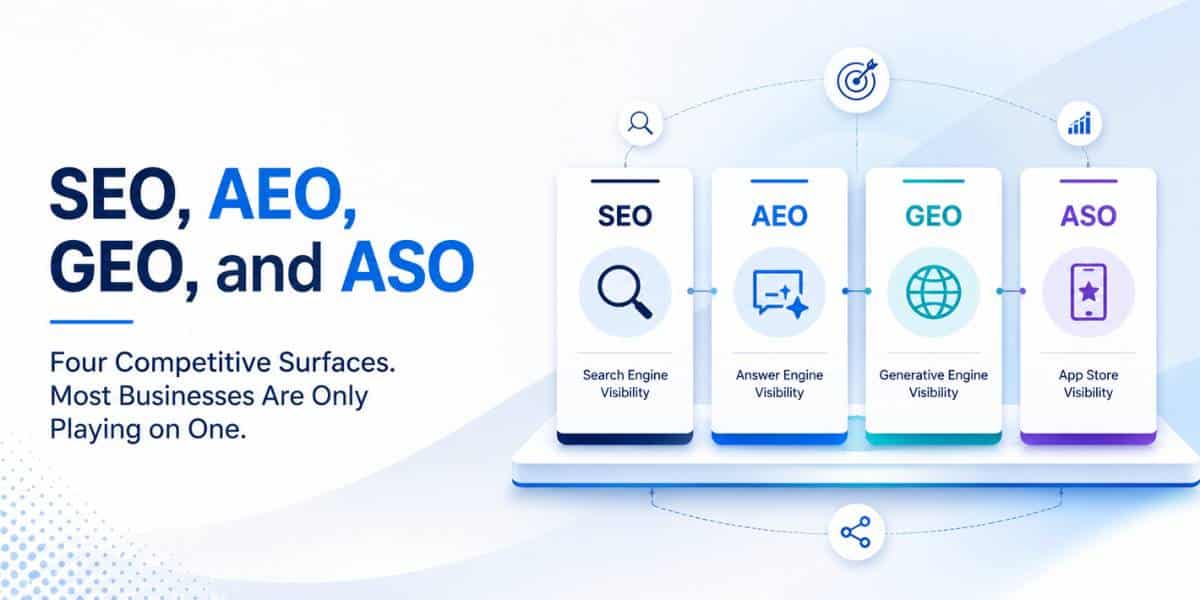
This guide walks through the four pillars of modern search visibility: SEO, AEO, GEO, and ASO. We will explain what each one is, how they differ, and what your small business needs to do for each.
Quick Definitions
Before we dive in, here are the four terms you need to know:
● SEO (Search Engine Optimization): Getting your website to rank in traditional search engines like Google and Bing.
● AEO (Answer Engine Optimization): Getting your business cited by AI chatbots like ChatGPT, Claude, Gemini, and Perplexity when they answer user questions.
● GEO (Generative Engine Optimization): Getting your content included in AI-generated search summaries, like Google AI Overviews and Bing Copilot.
● ASO (Agentic Search Optimization): Getting your business chosen, booked, or purchased by AI agents acting on behalf of a user.
These are not the same thing. They overlap in places, but the rules, the ranking factors, and the optimization tactics are different for each one. Let us break them down.
SEO: The Foundation You Already Know
Search Engine Optimization is the discipline most small business owners are familiar with. The goal is simple: when someone Googles a phrase like “plumber near me” or “best running shoes for flat feet,” your website appears near the top of the results page.
Classic SEO ranking factors include:
● Keyword research and targeting
● High-quality content that matches search intent
● Technical site health (speed, mobile-friendliness, crawlability)
● Backlinks from reputable sites
● On-page elements like title tags, meta descriptions, and headers
● Local signals like Google Business Profile and citations
SEO still matters. A massive amount of search traffic still flows through traditional Google results, and the technical foundation you build for SEO supports everything else. But here is the catch: the click-through rate from traditional Google results has dropped sharply. Why? Because Google now answers many questions directly on the results page using AI Overviews, and millions of users have moved their question-asking to ChatGPT and other AI tools.
In other words, ranking number one on Google is no longer enough. You also have to be quoted, cited, recommended, and selected by the AI tools that increasingly stand between your customer and a traditional search result.
AEO: Getting Cited by AI Chatbots
Answer Engine Optimization is the practice of structuring your content so AI chatbots like ChatGPT, Claude, Gemini, and Perplexity reference your business when answering user questions.
Here is the difference. With SEO, a user types a query and clicks a link. With AEO, a user asks a chatbot a question and gets a synthesized answer that may or may not mention your brand. If your business is not part of that answer, you are invisible.
To optimize for AEO, focus on:
● Clear, fact-based content. AI models prefer content that answers questions directly, in plain language, with verifiable facts.
● Question-and-answer formatting. Pages structured around real questions your customers ask perform better in AI citations.
● Brand mentions across the open web. AI models learn what is real and reputable from how often your brand appears in trustworthy sources. Press coverage, podcast appearances, industry directories, and Wikipedia all matter.
● Structured data and schema markup. Helping AI parse your content correctly improves the chance it gets used.
● Authoritative sourcing. AI models cite sources they trust. Build that trust by publishing original research, expert quotes, and well-cited content.
The big shift is this: AEO is less about ranking and more about being recognized as a trusted source by the AI itself. You cannot buy your way to the top of a chatbot answer. You earn it by being a credible, well-referenced part of your industry’s information ecosystem.
GEO: Showing Up in AI Search Summaries
Generative Engine Optimization is closely related to AEO, but it focuses specifically on the AI-generated summaries that now appear at the top of search results pages. Google AI Overviews, Bing Copilot, and similar features pull from multiple sources and stitch together a summary answer, often with links to the sources used.
GEO is about being one of those sources.
If a user searches “how to choose a personal injury lawyer in Florida” and Google generates a summary answer, you want your firm to be one of the cited links. The same principle applies for product searches, how-to questions, and local service queries.
To optimize for GEO:
● Write for extractability. Use short, declarative sentences that an AI can lift cleanly into a summary.
● Use clear headings and subheadings. AI summaries often pull from the most scannable sections of a page.
● Include data, statistics, and specifics. Generic content rarely gets cited. Pages with original numbers, percentages, and expert insights get pulled in more often.
● Build topical authority. A site with deep, comprehensive coverage of one subject is more likely to be cited than a site that touches on a topic once.
● Optimize for E-E-A-T. Experience, Expertise, Authoritativeness, and Trustworthiness signals (author bios, credentials, citations) carry significant weight in generative summaries.
GEO and AEO share a lot of DNA. The main difference is the surface. AEO is about chatbot conversations. GEO is about AI summaries inside search results pages.
ASO: Getting Chosen by AI Agents
Agentic Search Optimization is the newest and arguably most important pillar. It is the practice of preparing your business to be selected, booked, or purchased by AI agents acting on behalf of a user.
Here is what that looks like in practice. A customer no longer Googles “best dog boarding in West Palm Beach.” Instead, they tell their AI agent, “Find me a dog boarder for next weekend, book it, and add it to my calendar.” The agent then researches options, compares them on price, availability, reviews, and policies, and completes the booking, often without the user ever visiting a website.
If your business is not structured for an agent to find, evaluate, and transact with, you do not get the booking. The customer never sees you.
This is already happening with travel, food delivery, and basic e-commerce. It is rapidly expanding into local services, B2B procurement, professional services, and more.
To optimize for ASO, focus on:
● Machine-readable business data. Hours, services, pricing, availability, locations, and policies all need to be published in clean, structured formats. NAP (name, address, phone) consistency across the web is table stakes. Product feeds, service schemas, and live availability data are the next layer.
● API and agent-friendly endpoints. If an AI agent needs to check your inventory, get a quote, or book an appointment, can it do that programmatically? Businesses with public APIs, MCP servers, or partner integrations with platforms agents already use will win.
● Reviews and reputation signals at scale. Agents use reviews as a primary trust filter. Volume, recency, sentiment, and response rate all matter. An agent comparing three businesses will heavily weight the one with the strongest, freshest review profile.
● Frictionless transactions. Online booking, transparent pricing, instant quotes, and clear cancellation policies all make your business easier for an agent to choose. Hidden phone-only pricing or “call for a quote” workflows lose every time to a competitor with a “book now” button.
● Structured data for products and services. Product schema, service schema, FAQ schema, and offer schema let agents understand what you sell, what it costs, and whether it fits the user’s request.
● Agent-readable trust signals. Certifications, licenses, insurance, awards, and credentials should be clearly published in machine-readable form, not buried in a PDF or an “About” page.
ASO is the convergence point. SEO content is what an agent reads to learn about you. AEO mentions are what teach the agent your brand exists. GEO citations are how the agent confirms you are credible. ASO is what closes the deal.
How They All Fit Together
Here is the most important thing to understand. SEO, AEO, GEO, and ASO are not competitors. They are layers in a stack.
SEO builds the foundation: a fast, well-structured, content-rich site. AEO and GEO put your brand inside the AI conversations and summaries customers consume. ASO makes sure that when an AI agent is ready to choose, book, or buy, your business is the one selected.
A practical small business approach looks like this:
1. Get your SEO foundation right first. Fast site, clean structure, good content, accurate Google Business Profile, real backlinks.
2. Layer in AEO. Restructure key pages around the questions your customers actually ask. Add schema markup. Earn mentions in industry publications.
3. Add GEO touches. Write for extractability. Use data and clear headings. Build topical depth on the services you sell.
4. Build for ASO. Audit how easily an AI agent could find, evaluate, and transact with your business. Fix the friction points.
You do not have to do everything at once. But ignoring three of the four pillars and hoping traditional SEO carries you through 2026 and beyond is a losing strategy.
What Small Businesses Should Do This Quarter
If you are running a small business and feeling overwhelmed, here is a 90-day starting point:
● Audit how your business currently appears in ChatGPT, Claude, Gemini, and Perplexity. Ask each one questions a customer would ask, and see if you are mentioned.
● Run a Google AI Overviews check on your top ten target keywords. Are you cited? Who is?
● Identify your top five most important pages and rewrite them with clear question-and-answer structure.
● Add or expand schema markup across your site, including product, service, FAQ, and offer schemas.
● Test an agent flow yourself. Ask an AI agent to book a service like yours and watch what it does. If your business does not show up or cannot be booked, that is your ASO gap.
● Build a quarterly plan for earning brand mentions in publications your customers read.
The businesses that win in 2026 will not be the ones with the biggest budgets. They will be the ones that recognized the search landscape changed and adapted faster than their competition.
The Takeaway
SEO is no longer enough. AEO, GEO, and ASO each represent a distinct surface where your customers, and increasingly the AI agents acting for them, search, ask, and decide. Each one has its own optimization playbook. Each one rewards businesses that show up consistently and authoritatively.
The good news? Most small businesses have not figured this out yet, and almost none have started preparing for agentic commerce. There is still a window to get ahead of your competition. The window will not stay open forever.