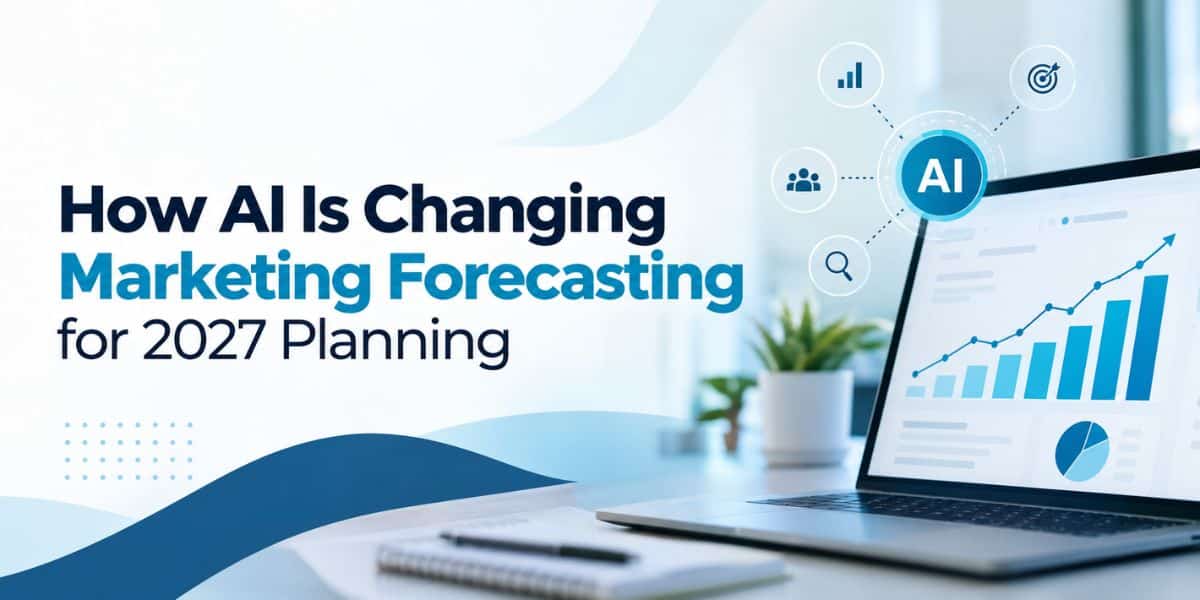
Short Answer: AI forecasting uses machine learning models to analyze historical campaign data, market signals, and real-time performance in order to predict marketing outcomes, spend requirements, and pipeline impact before a budget cycle starts. For 2027 planning, it matters because it replaces static, quarter-old spreadsheets with forecasts that update as conditions change, giving leadership a clearer view of what a marketing dollar will actually return. Businesses that adopt it now are budgeting with better data than the ones still guessing.
Key Takeaways
- AI marketing forecasting models continuously ingest campaign, CRM, and market data instead of relying on a single point-in-time estimate, which is why forecasts stay accurate as conditions shift mid-quarter.
- CMOs allocated an average of 15.3% of their marketing budgets to AI initiatives in 2026, but only 30% report their organizations are mature enough to scale it, according to Gartner’s 2026 CMO Spend Survey.
- Companies with mature AI readiness allocate 21.3% of their marketing budget to AI and run overall marketing budgets averaging 8.9% of company revenue, well above the survey-wide average.
- Marketers project AI will power more than half of all marketing activities within three years, up from usage that has more than tripled since 2022, according to Duke University’s Fuqua School of Business CMO Survey.
- AI forecasting doesn’t replace a marketing strategy. It replaces the guesswork underneath one, which is a different thing entirely.
- The businesses gaining ground in 2027 planning cycles are the ones treating forecasting as a system to build, not a report to request once a quarter.
What Is AI Forecasting in Marketing?
AI forecasting in marketing is the use of machine learning models to predict future performance, spend needs, and revenue outcomes based on historical and real-time data rather than manual estimation. Instead of a planner extrapolating last year’s numbers forward with a growth assumption bolted on, the model ingests campaign performance, seasonality, pipeline velocity, and market signals, then outputs a range of likely outcomes tied to specific spend levels.
This is where the term ai marketing forecasting gets used almost interchangeably with AI forecasting, though there’s a slight distinction worth knowing. AI forecasting is the broader discipline, applied in finance, supply chain, and operations too. AI marketing forecasting narrows that same technique to marketing-specific inputs: channel mix, creative fatigue, lead-to-close timelines, and cost-per-acquisition trends by segment.
Here’s the part most vendors skip: the output isn’t a single number. It’s a probability range. A model might tell you that $50,000 in paid search spend next quarter has a 70% chance of producing between 180 and 220 qualified leads, given current conversion trends. That range is more useful to a CFO than a confident-sounding point estimate that turns out to be wrong by 40%.
How Does AI Marketing Forecasting Differ From Traditional Budget Planning?
Traditional marketing budget planning is built once or twice a year, usually by taking the prior period’s results and applying a growth percentage that leadership feels comfortable defending. It’s a snapshot. Once it’s locked, it stays locked until the next planning cycle, regardless of what happens in the market.
AI marketing forecasting is built as a living model. It re-runs as new data comes in, so a forecast built in October looks different by December if conversion rates shifted or a competitor entered the market. That’s not a minor technical difference. It changes who gets blamed when a forecast misses, because the model shows exactly which input moved and by how much.
Factor Traditional Forecasting AI Marketing Forecasting Update frequency Quarterly or annually Continuous, as new data arrives Data inputs Prior-period totals, manual assumptions Campaign data, CRM data, market signals, seasonality Output format Single point estimate Probability range tied to spend scenarios Accuracy over time Degrades as the quarter progresses Improves as more data feeds the model Budget agility Locked until next cycle Supports mid-cycle reallocation
The tradeoff is setup cost. A traditional forecast can be built in an afternoon in a spreadsheet. An AI forecasting model needs clean historical data, a defined measurement window, and someone who understands what the model is and isn’t accounting for. Skip that step and the model just automates bad assumptions faster.
Why Does AI Forecasting Matter for 2027 Budget Planning?
Because the businesses that got their 2026 forecasts wrong are walking into 2027 planning with less credibility and less room to ask for more budget. That’s the blunt version, and it’s worth saying plainly.
Marketing budgets aren’t expanding much. Gartner’s 2026 survey found that overall marketing budgets sat at 7.8% of company revenue, barely moved from 7.7% the year before, while 56% of CMOs said they didn’t have the budget required to deliver on their 2026 strategy. Flat budgets mean every dollar has to be justified with more precision than “it worked last time.” A forecast that adjusts in real time gives a marketing leader the ability to say, with data, “this channel is underperforming the model, here’s where we’re moving the next $10,000” instead of waiting until Q1 review to notice the miss.
There’s also a credibility angle that’s easy to underrate. When a marketing partner can show a CFO a forecast range and then show the actual result landing inside that range, month after month, that’s a different conversation than defending a single number that was wrong by half. Trust gets built on accuracy, not optimism.
What Changed in 2026?
Two things shifted the ground under 2027 planning, and both are worth naming specifically rather than waving at “AI adoption” in general.
First, AI’s share of marketing budgets became a formal line item rather than an experimental one. Gartner’s survey of 401 CMOs, fielded January through March 2026, put average AI budget allocation at 15.3%, with organizations that had built real AI readiness allocating 21.3%. That gap between the average and the ready is the story. Most companies are spending on AI without the data foundation to get a return on it.
Second, forecasting itself became one of the activities AI is doing more of, not just supporting from the sidelines. Duke Fuqua’s CMO Survey, its 35th edition, found that AI use in marketing has more than tripled since 2022, and marketers now project AI will handle more than half of all marketing activities within three years. Even Generative Engine Optimization, a discipline that barely existed two years ago, is now used by roughly 4 in 10 companies surveyed. Predictive analytics for market and customer insights showed up as a named driver of that shift, not a side effect of it.
Put those together and the 2027 planning cycle is the first one where a business without some form of AI-assisted forecasting is genuinely behind, not just slow to adopt a trend.
How Accurate Is AI Marketing Forecasting?
More accurate than a spreadsheet extrapolation, but only when the underlying data is clean and the model is scoped to what it can actually know. That’s the honest answer, and anyone promising a forecasting tool that’s always right is selling something.
Accuracy improves with three conditions: enough historical data to establish a real baseline (most models need at least 12 to 18 months of consistent tracking), clean attribution so the model isn’t learning from broken conversion data, and a defined confidence interval instead of a single number. A model that outputs “we’ll generate 200 leads next quarter” is less useful, and less honest, than one that outputs “180 to 220 leads, 70% confidence, based on current spend and conversion trends.”
Where AI forecasting struggles is with genuinely novel events: a new product launch with no historical analog, a sudden algorithm change, a competitor entering the market overnight. In those cases the model needs a human to flag the anomaly and adjust the inputs. This is where a lot of forecasting projects fail quietly. The model runs, produces numbers, and nobody’s watching for the moment those numbers stop making sense. Our take: any AI forecasting model without a human reviewing it monthly is just a fancier version of the guess it replaced.
Which Businesses Should Use AI Forecasting for 2027 Planning?
Not every business needs the same level of forecasting sophistication, and building a model heavier than the data supports wastes budget on infrastructure instead of results.
| Business Scenario | Recommended Approach |
|---|---|
| Under 12 months of consistent marketing data | Build the data foundation first; hold off on full AI forecasting |
| Established channels, 12+ months of clean data, single market | Channel-level AI forecasting with monthly human review |
| Multi-location or multi-market business | AI forecasting segmented by location, tied to AI optimization and local search visibility data |
| Enterprise with dedicated analytics resources | Full predictive model integrated with CRM and sales pipeline data |
The common thread across every scenario: the model is only as good as the tracking underneath it. A business that can’t currently tell you cost-per-lead by channel with confidence isn’t ready to trust an AI forecast of that same number six months from now. That same clean, structured tracking is also what strengthens AI optimization work, since a brand’s visibility in AI search results and its forecasting accuracy both run on the same underlying data.
What Should You Never Do When Building an AI Forecasting Model?
Never feed a forecasting model broken attribution data and trust the output. If your ROI tracking is inconsistent across channels today, an AI model won’t fix that. It’ll just make confident-sounding predictions built on a shaky foundation, and a confident wrong number is more dangerous than an honest “we don’t know.”
Never treat the forecast as fixed once it’s built. The entire value of ai forecasting over a traditional annual budget is that it updates. Locking it in and revisiting it once a quarter defeats the purpose and leaves you back where you started.
Never skip the human review step to save time. The model catches patterns. It doesn’t catch context, like a competitor’s pricing change or a sales team headcount cut that will affect close rates regardless of what marketing does.
FAQs
What does AI forecasting mean in marketing?
AI forecasting in marketing means using machine learning models to predict campaign performance, budget needs, and revenue outcomes from historical and real-time data, rather than relying on a manually built estimate that stays fixed for an entire planning cycle.
Is AI marketing forecasting the same as predictive analytics?
They overlap heavily. Predictive analytics is the broader technique of using data to forecast future outcomes across any business function. AI marketing forecasting applies that same technique specifically to marketing spend, channel performance, and pipeline outcomes.
How much data do I need before AI forecasting is accurate?
Most models need 12 to 18 months of consistent, clean historical data to establish a reliable baseline. Businesses with less history can still use AI-assisted trend analysis, but the confidence intervals will be wider until more data accumulates.
Does AI forecasting replace a marketing strategy?
No. AI forecasting predicts likely outcomes under current conditions; it doesn’t decide what those conditions should be. Strategy still requires human judgment about which markets, offers, and channels to pursue.
Can small businesses use AI forecasting, or is it only for enterprise marketers?
Small businesses can use it, but the return depends on having clean, consistent tracking first. A business without reliable cost-per-lead data by channel should build that foundation before investing in a full forecasting model.
How often should an AI marketing forecast be updated?
It should update continuously as new campaign data comes in, with a human reviewing the output on a monthly cadence at minimum to catch drift or anomalies the model can’t contextualize on its own.
What’s the biggest risk of AI forecasting for 2027 budgets?
The biggest risk is feeding the model inconsistent or broken attribution data and trusting the output anyway. A forecasting model amplifies the quality of the data underneath it. It doesn’t correct for bad data on its own.
How Do You Get Started With AI Forecasting Before Q1 2027?
Start by auditing what you can actually measure today. If cost-per-lead, conversion rate by channel, and average deal velocity aren’t tracked consistently, that’s the first project, not the forecasting model itself. A model built on 2027-clean data outperforms one built on 2026’s patchwork every time.
From there, define a forecasting window that matches your sales cycle. A business with a 30-day sales cycle can forecast monthly. A business with a nine-month enterprise sales cycle needs a longer view or the forecast will chase noise instead of signal. This ties directly into how well you’re already measuring marketing effectiveness, since a forecasting model inherits every gap in your current measurement approach.
Finally, decide who owns the monthly review. Someone needs to look at the forecast against actual results, flag drift, and adjust inputs. Without that person, the model degrades quietly and nobody notices until the number’s badly wrong.
A forecasting system built on clean data is table stakes for 2027 planning. See how THAT Agency’s digital marketing services build that foundation before your next budget cycle locks.