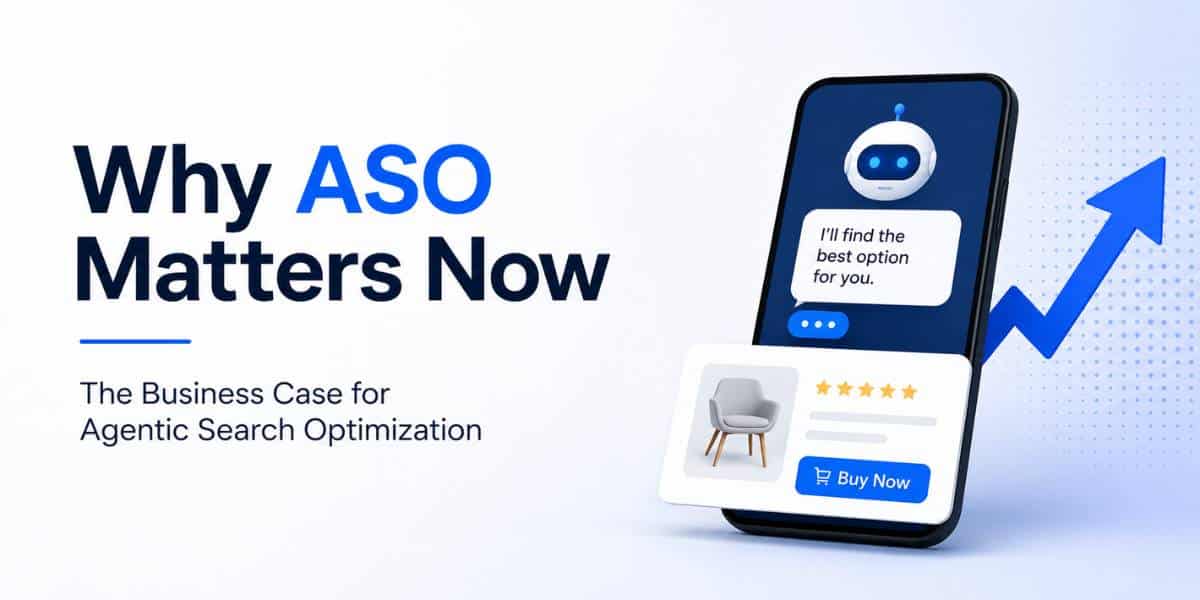
Short Answer: Agentic Search Optimization (ASO) prepares your business to be selected and transacted with by AI agents acting on behalf of consumers. It matters now because Bain projects up to $500 billion in US agentic commerce by 2030, Morgan Stanley says roughly 23% of Americans already bought something via AI last month, and the businesses getting their product data, reviews, and APIs agent-ready will capture share from competitors still optimizing only for human shoppers.
Key Takeaways
● Bain & Company estimates the US agentic commerce market will reach $300 to $500 billion by 2030, or 15-25% of total US eCommerce.
● Morgan Stanley forecasts $190 to $385 billion in US agentic spending by 2030, with 23% of Americans already making AI-driven purchases in the past month.
● The US Chamber of Commerce reports nearly 60% of small businesses now use AI, up 18% year over year, with 80% saying competitor AI use is forcing them to accelerate.
● Pages with structured data are cited 3.1x more often in Google AI Overviews. If your product pages are not machine-readable, an AI agent cannot recommend you.
● Spec-driven categories (groceries, supplies, commodities) flip to agentic first. Identity-driven categories (fashion, luxury) follow. Most small business eCommerce is in the first wave.
Here is what most small business owners are missing. The AI conversation has been about chatbots and content for 18 months. The next 18 months are about agents that actually buy. That is a different challenge, and the businesses preparing now will look prescient in 2027.
SEO got you ranked. AEO got you mentioned in chatbot answers. GEO got you cited in AI search summaries. ASO is what gets you chosen when an AI agent is doing the buying. And the numbers backing this shift are no longer projections from marketing blogs. They are coming from Bain, Morgan Stanley, Gartner, and the US Chamber of Commerce.
The Numbers Behind Agentic Commerce in 2026
| Forecast | Source | Implication |
| $300B to $500B US agentic commerce by 2030 | Bain & Company | 15-25% of US eCommerce |
| $190B to $385B by 2030 | Morgan Stanley AlphaWise | 10-20% US market share |
| 23% of Americans bought via AI last month | Morgan Stanley | Already mainstream behavior |
| 40% of enterprise apps embed AI agents by 2026 | Gartner | B2B procurement automating too |
| 30-45% of US consumers use GenAI for product research | Bain Consumer Lab | Discovery already moved |
| 60% of small businesses now use AI | US Chamber of Commerce | The race is on |
The 4 Reasons ASO Matters Right Now
1. The Money Is Already Moving
This is no longer a future state. Morgan Stanley’s AlphaWise survey shows roughly 23% of Americans made purchases using AI in the past month. About half of LLM users researched and compared prices, and 30 to 40 percent reported making purchases off those interactions. Salesforce data cited by Bain put AI-influenced US Black Friday sales at $3 billion.
The pure agentic share of eCommerce is still small (under 1% of traffic today), but third-party AI agent traffic to retailers grew 300% in the first half of Black Friday 2025. The base is small. The slope is what matters.
● Waiting to “see how this plays out” means missing the early-mover window.
● The category leaders in 2030 are being chosen right now based on which businesses are agent-ready.
2. Bain Says $500 Billion. Morgan Stanley Says $385 Billion. Both Are Big.
The most credible institutional forecasts: Bain puts US agentic commerce at $300 to $500 billion by 2030 (15-25% of total US eCommerce). Morgan Stanley puts it at $190 to $385 billion (10-20% of US market share).
These are not consultancy hype numbers. Bain is one of the most conservative strategy firms in the world. Morgan Stanley AlphaWise has run stated-preference consumer panels since 2010. When both independently land on “agents will run a quarter of US eCommerce by 2030,” that is signal, not noise.
● A quarter of online sales touched or completed by agents is a structural change.
● Your business is either in the path of that money or outside it.
3. Spec-Driven Categories Are Flipping First
Bain identifies a clean split. Spec-driven categories (groceries, household supplies, CPG, replenishment, anything where price and convenience win) flip to agentic first. Identity-driven categories (fashion, luxury, home decor) flip later.
Look at what most small business eCommerce actually sells. Pet supplies. Office consumables. Health and beauty staples. Auto parts. Replacement filters. Local home services. These are exactly the categories where AI agents are most useful, where price-and-availability optimization beats brand storytelling, and where the agent will decisively recommend whichever business has the cleanest product data.
● If your buyer cares more about “what fits my need” than “what feels right,” your category is in the first wave.
● Brand storytelling matters less. Machine-readable specs matter more.
4. AI Agents Read Structured Data, Not Marketing Copy
This is the single most concrete shift since mobile-first design. Pages with structured data are cited 3.1x more often in Google AI Overviews. 71% of pages cited by ChatGPT and 65% of pages cited by Google AI Mode include structured data.
Translation: an AI agent comparing three competing products does not read your hero banner or your founder story. It reads schema markup, product feeds, JSON-LD, and API responses. If your site has gorgeous design but no structured product, offer, review, or FAQ schema, an agent cannot understand what you sell. A competitor with worse design and complete structured data will be recommended over you.
● Schema markup is no longer a nice-to-have for SEO. It is the price of admission for agentic commerce.
How eCommerce Specifically Gets Reshaped
| What Changes | What It Means | What to Do |
| Discovery moves into the agent | Customer never sees your homepage | Make product data machine-readable |
| Comparison in milliseconds | Brand premium erodes for commodities | Compete on data quality and price clarity |
| Reviews become primary trust filter | Agents weight Google, Trustpilot, Reddit | Drive review velocity and respond to negatives |
| Checkout may happen outside your site | Customer data and retargeting at risk | Build proprietary email and SMS lists now |
| B2B procurement automates | Sales calls compress for spec buys | Publish pricing, availability, APIs publicly |
The reviews row is worth lingering on. AI agents do not believe your marketing. They believe other people’s reviews of your marketing. A thin or stale review profile loses to a competitor’s fresh one every time.
The ASO Action List for This Quarter
1. Audit your structured data. Run your top pages through Google’s Rich Results Test and Schema.org Validator. You want Product, Offer, Service, Review, FAQ, and Organization schemas in place.
2. Test your business inside the agents. Ask ChatGPT, Claude, Gemini, and Perplexity questions your customer would ask. Where do you show up? What does the AI say about you?
3. Test an actual agent flow. Ask an AI agent to find and book something in your category. Watch what it does. The friction it hits is the friction every customer will hit.
4. Drive review velocity. Recent reviews, not lifetime counts. AI agents weight recency heavily.
5. Publish pricing and availability. “Call for a quote” loses to “instant quote” every time an agent compares.
6. Build first-party email and SMS lists aggressively. If checkout migrates to third-party platforms, the customer relationship migrates with it. Owned channels are your hedge.
Frequently Asked Questions
What is the difference between AEO, GEO, and ASO?
AEO is being mentioned by AI chatbots when they answer questions. GEO is being cited as a source in AI search summaries. ASO is being chosen and transacted with by AI agents. AEO and GEO are visibility. ASO is the close.
Is agentic commerce just hype?
No. Forecasts come from Bain, Morgan Stanley, McKinsey, and Gartner, not marketing blogs. Morgan Stanley says 23% of Americans already bought via AI last month. Bain projects $300 to $500 billion by 2030.
How long do small businesses have to prepare?
12 to 18 months for spec-driven categories (CPG, groceries, supplies, replenishment). 24 to 36 months for identity-driven categories (fashion, luxury). By 2027, businesses without ASO readiness will start losing meaningful share.
What is the single most important ASO move?
Structured data. Pages with schema are cited 3.1x more often in Google AI Overviews. 71% of pages cited by ChatGPT include structured data. If you do nothing else this year, get Product, Offer, FAQ, and Review schema on every important page.
Will AI agents actually buy things autonomously?
They already do. Walmart’s Sparky, Amazon’s Rufus, Google’s Shopping agent, and OpenAI’s Operator all support varying degrees of autonomous purchase. Spec-driven and repeat purchases (groceries, supplies, subscriptions) are flipping to autonomous first.
Does this make traditional SEO obsolete?
No. SEO is still the foundation. Agents read content. Content needs to rank to be read. SEO + AEO + GEO + ASO is the new stack. Skip ASO and you are leaving the close to your competition.
Final Verdict
Three things are happening simultaneously and they all point the same direction. Bain and Morgan Stanley both project hundreds of billions of US agentic commerce by 2030. Roughly a quarter of Americans are already buying via AI today. The infrastructure that wins (machine-readable product data, fresh reviews, published pricing, working APIs) takes months to build, not days.
Start now or arrive late. The businesses that get ASO right in 2026 will be the ones being recommended by agents in 2027 and 2028. The businesses that wait will be the ones wondering why their traffic and sales dropped while their competition’s grew.
What Changed 2025 to 2026
● Bain and Morgan Stanley both published institutional forecasts of $190B to $500B in US agentic commerce by 2030.
● Google launched the Universal Commerce Protocol. Shopify launched Agentic Storefronts. OpenAI paused Instant Checkout to focus on discovery.
● AI agent traffic to retailers grew 300% in the first half of Black Friday 2025.
● US Chamber of Commerce reported small business AI adoption hit ~60%, up 18% year over year.