
Choosing the right marketing partner can feel overwhelming. There are large agencies, small teams, freelancers, and everything in between. Many business owners and marketing leaders find themselves asking the same question: is a boutique creative agency the right fit for our goals?
The agency landscape has changed significantly over the past few years. Many businesses are moving away from large, layered agency structures and looking for marketing partners that provide faster communication, clearer accountability, and strategies tied directly to growth. This shift has increased interest in boutique creative agencies, especially among businesses that value flexibility and closer collaboration.

In the first stages of that decision, it helps to understand what a boutique creative agency really is, how it works, and when it makes the most sense to hire one. This guide explains the boutique agency meaning in clear, practical terms. It is written for leaders who want straightforward answers, clear expectations, and marketing systems that support steady growth.
What Is a Boutique Creative Agency?
A boutique creative agency is a smaller marketing agency that works with a limited number of clients at one time. Instead of trying to serve every industry or offer every possible service, a boutique creative agency focuses on a defined set of skills and clients it can support well.
The main idea behind a boutique creative agency is focus. These agencies build close working relationships and take time to understand your business, your audience, and your goals. The same people who help plan your strategy are often the ones helping execute and review the work.
Today, many boutique agencies compete directly with much larger firms by using leaner teams, specialized expertise, AI-supported workflows, and highly focused strategies. In many cases, businesses are prioritizing agility and strategic involvement over agency size alone.
Common traits of a boutique creative agency include:
- Smaller teams with hands on involvement from senior staff
- Clear areas of focus like SEO, web design, paid ads, or content
- Direct communication instead of layers of account management
- Flexible plans that adjust based on performance
- Long term partnerships instead of short term projects
This structure often feels more personal and easier to manage than working with a large agency. Many boutique agencies specialize deeply in areas likeB2B digital marketing strategies, local and regional SEO, or high intent lead generation rather than broad awareness campaigns.
Why Businesses Are Choosing Boutique Agencies More Often
Many businesses today are looking for agency relationships that feel more collaborative and strategically involved. Instead of managing layers of communication and generic reporting, companies increasingly want direct access to the people shaping marketing strategy and execution.
- Faster communication and response times
- More flexibility when priorities change
- Closer collaboration with senior strategists
- Clearer reporting tied to outcomes
- More transparency around performance and recommendations
- Marketing strategies that adapt as the business grows
This shift is one reason boutique creative agencies have become more appealing to businesses focused on long term growth and measurable ROI.
Boutique Agency Meaning Explained in Plain Language
What boutique agency meaning really refers to
The phrase boutique agency meaning is not about being trendy or exclusive. It describes how an agency chooses to work.
In simple terms, boutique agency meaning comes down to three ideas:
- Focused services instead of trying to do everything
- Strong relationships instead of quick handoffs
- Clear strategy instead of one size fits all plans
A boutique agency chooses quality over volume. It limits the number of clients so each account gets real attention. This approach pairs naturally with structured frameworks likemarketing strategy examples that evolve as results come in, rather than staying static for months.
Boutique agencies vs freelancers
Some people assume a boutique creative agency is just a freelancer with a nicer website. There is an important difference.
A boutique creative agency usually includes:
- A dedicated strategist or account lead
- Designers, developers, or marketers working as a team
- Established systems for reporting and review
- Clear timelines and processes
Freelancers often work alone and may not offer the same level of support, continuity, or scalability. Boutique agencies are better positioned to connect work back to outcomes likeinbound leads vs outbound leads, customer acquisition, and long term growth.
One reason businesses often choose boutique agencies over freelancers is continuity. While freelancers may offer strong individual skills, boutique agencies usually provide broader strategic support, backup resources, reporting systems, and cross-functional collaboration that can better support long-term growth.
How a Boutique Creative Agency Is Different from a Large Agency
If we are choosing between a boutique creative agency and a large agency, the “best” option is not about who has the biggest team. It is about which model fits the way we work, how fast we need to move, and how closely we want marketing tied to revenue and lead quality.
A boutique creative agency often feels more like an in house partner. A large agency often feels more like a structured vendor. Both can do good work, but they usually operate in very different ways. This difference becomes especially clear when comparing strategic depth versus scale driven execution, a distinction often discussed when evaluatingmarketing vs advertising agencies.
Below is a deeper breakdown of the differences that tend to matter most to marketing minded leaders.
Team access and communication
Large agencies are built to handle volume. To manage many accounts at once, they usually add layers. That can protect their time, but it can also slow things down for the client.
A common large agency setup looks like this:
- A salesperson sells the engagement and may disappear after onboarding
- An account manager becomes the main point of contact
- Work is handled by specialists you may never meet
- Questions move through multiple people before you get an answer
This can work fine when the project is simple or highly standardized. It can get frustrating when we need quick changes, clear answers, or strategy support that goes beyond basic task management.
With a boutique creative agency, communication usually feels more direct:
- We talk with the strategist and the people doing the work
- Feedback is easier to apply because the same team is involved
- Fewer handoffs means fewer details get lost
- Meetings feel more productive because the right people are in the room
Direct communication supports faster response times and clearer accountability, especially when paired with ongoingcompetition monitoring and competitive content analysis.
Strategy and flexibility
Large agencies tend to rely on established systems that work across many accounts. This helps them deliver at scale, but it can also create a “template” feel. That template might not match our market, our goals, or our internal sales process.
A boutique creative agency is usually more flexible because it is built to focus, not to scale volume. They can adjust SEO, paid media, or content strategies in real time based on performance insights from tools, platforms, and reporting systems like those outlined intop SEO tools of the year and modern analytics stacks.
How AI and Automation Are Changing Boutique Agencies
AI and automation tools are allowing boutique agencies to compete more effectively with larger firms. Leaner teams can now handle reporting, research, optimization, and content workflows more efficiently while spending more time on strategy and decision making.
- Faster reporting and data analysis
- Improved campaign optimization workflows
- More efficient content planning and SEO research
- Better scalability without adding unnecessary overhead
- More time spent on strategy instead of repetitive tasks
This shift allows many boutique agencies to stay agile while still delivering sophisticated marketing support.
Reporting and clarity
Reporting is where many agency relationships either build trust or lose it.
Large agencies often send reports that look polished but do not answer the real questions. The report may show impressions, clicks, and traffic, but not what leadership cares about.
Boutique reporting often focuses on:
- Leads and lead quality
- Conversion rates and cost per lead
- Revenue influence where tracking is available
- Landing page performance and drop off points
- Clear wins, clear problems, and clear next steps
Modern marketing leaders increasingly want reporting that connects marketing activity to revenue impact, lead quality, and business growth rather than vanity metrics alone. Boutique agencies often position themselves around this type of visibility because closer client relationships allow for more customized reporting and strategy discussions.
Signs Your Business Has Outgrown Its Current Agency
- Slow communication and delayed updates
- Generic reporting with little strategic insight
- Campaigns producing weak lead quality
- Lack of proactive recommendations
- Limited transparency into performance
- Difficulty adapting strategy quickly
- Feeling like just another account instead of a partner
These are often signs that a business may benefit from a more collaborative and strategically involved agency relationship.
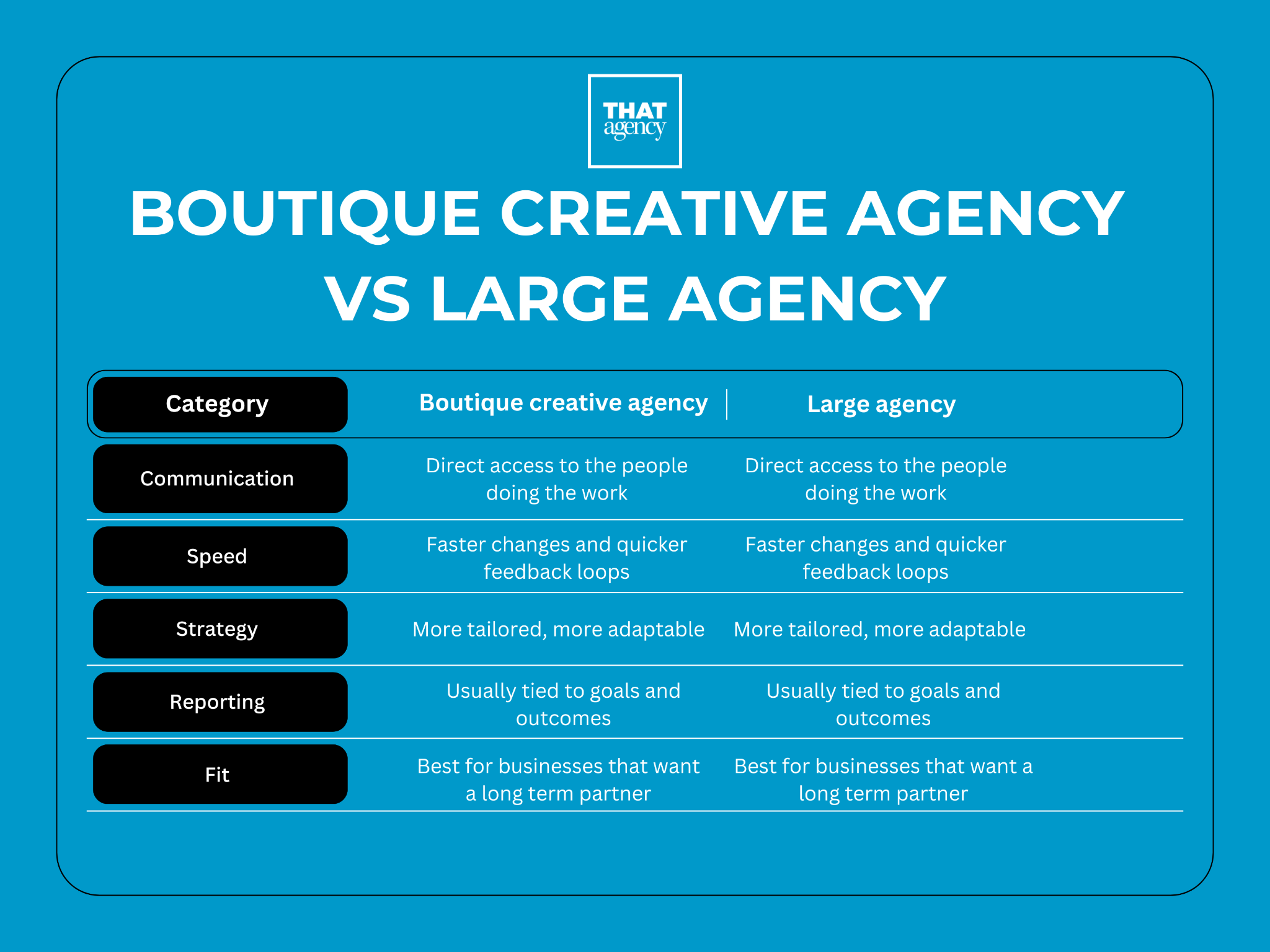
Quick comparison table
Here is a simple side by side view.
Pros and cons to consider
Boutique creative agency advantages
- More direct communication, fewer handoffs
- Faster updates when performance shifts
- Strategy feels tailored, not templated
- Reporting tends to be clearer and more outcome focused
- Often feels like an extension of our internal team
Boutique creative agency tradeoffs
- Limited capacity, they may not take every client
- Some boutique teams do not offer every service in house
- If we need global scale fast, it may not be the right model
Frequently Asked Questions About Boutique Creative Agencies
What is the difference between a boutique agency and a traditional agency?
Boutique agencies usually work with fewer clients and provide more direct communication, flexibility, and strategic involvement. Traditional agencies often operate with larger teams and more structured processes.
Are boutique agencies more affordable?
Pricing varies, but boutique agencies often focus more on efficiency and strategic value rather than large overhead structures. The best fit depends on goals and required support.
Can a boutique agency handle large campaigns?
Many boutique agencies successfully manage large campaigns by using specialized teams, strategic partnerships, and modern automation tools.
Do boutique agencies outsource work?
Some boutique agencies use trusted partners or specialists for specific tasks, but many keep core strategy and execution handled internally.
How do boutique agencies measure ROI?
Most boutique agencies focus on metrics tied to business outcomes such as lead quality, conversion rates, customer acquisition, and revenue influence.
What industries work best with boutique agencies?
Boutique agencies often work well for service businesses, local and regional brands, B2B companies, healthcare, professional services, and businesses focused on long-term growth.
Cost and Value Considerations
Pricing varies, but boutique agencies often focus on value instead of volume.
Your investment usually supports:
- Senior level planning and oversight
- Focused execution tied to goals
- Clear reporting and regular reviews
The lowest-cost agency option does not always produce the best long-term return. Many businesses eventually realize that slow communication, weak strategy, and disconnected execution can create hidden costs through wasted ad spend, lower lead quality, and missed growth opportunities.
Is a Boutique Creative Agency the Right Choice for You?
A boutique creative agency offers a focused and relationship driven approach to marketing. For leaders who value clarity, consistency, and steady growth, this model can provide the structure and support needed to move forward with confidence.
As businesses continue prioritizing flexibility, accountability, and measurable growth, boutique agencies are becoming an increasingly popular alternative to large, process-heavy firms. The best agency relationships are often built on communication, transparency, strategic alignment, and the ability to adapt quickly as business goals evolve.
Understanding boutique agency meaning helps you choose a partner that aligns with your goals and expectations. If you are looking for a marketing partner that feels collaborative, transparent, and results focused, a boutique creative agency may be the right next step. Contact us to learn more about how THAT Agency helps businesses build clear, reliable marketing systems that support long term growth.
{{cta(‘6a226701-0ca0-4e02-907a-24b833bcab5c’)}}